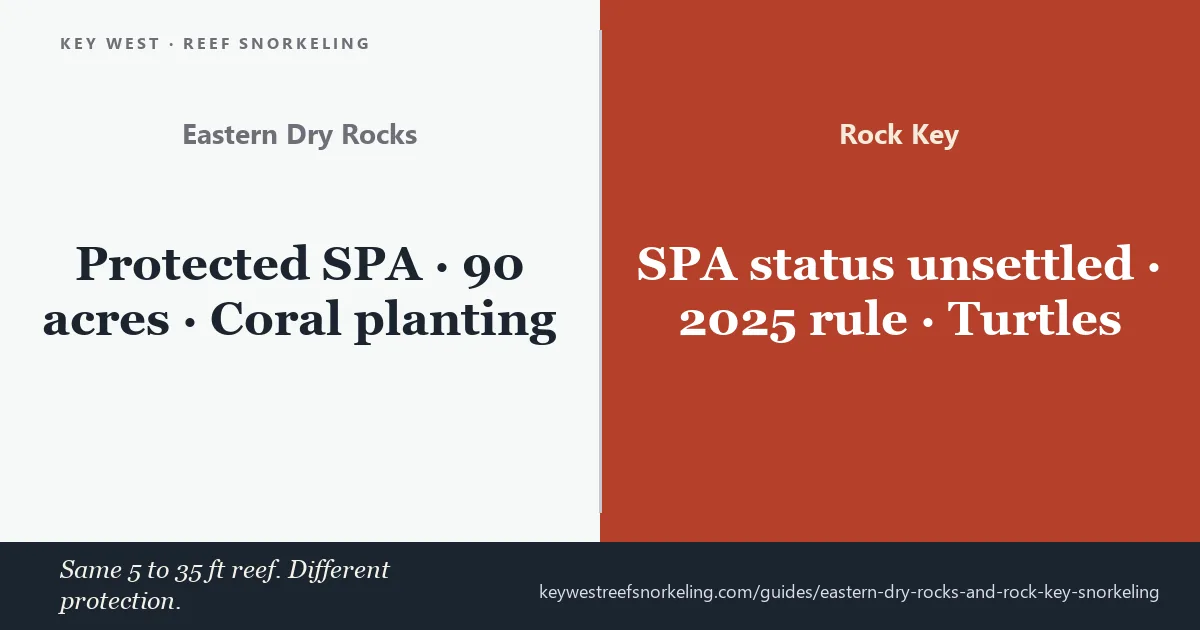
Eastern Dry Rocks and Rock Key are two small reefs on the Key West reef line, just east of the old Sand Key Lighthouse and roughly 6 to 7 miles off the island. NOAA gives both a depth of 5 to 35 feet, with a rubble zone and long fingers of coral split by sand and coral-filled canyons. Eastern Dry Rocks is a protected Sanctuary Preservation Area and one of NOAA’s seven Mission: Iconic Reefs restoration sites. Rock Key has been a preservation area too, but the 2025 sanctuary rule removed that designation where the new rule applies, so its status is unsettled.
You reach both by boat, and group trips do not promise either one: the captain picks the reef on the day. A trip with two stops raises your odds of seeing more than one reef. Fury’s Double Dip visits two reef locations in three hours, from $73 per person (checked November 2026), with 4.6 from 203 reviews on Viator.
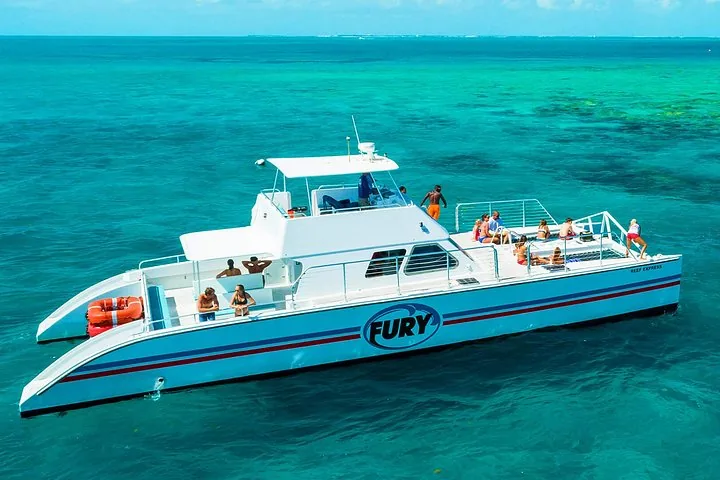
Key West Double-Dip Snorkel Tour-Two Stops, Twice the Fun!
- 4.6/5 (203 reviews)
- About 3 hours
- Free cancellation
- Operated by Fury Water Adventures
Includes Top-of-the-line snorkel gear · Snorkel instruction from the crew · Beer, wine, soda and water (alcohol after snorkeling)
You'll choose your date and complete the booking on Viator. Free cancellation under Viator's standard terms; the booking page shows the deadline.
Where the two reefs are
NOAA places Rock Key 1 mile east of Sand Key Light. Eastern Dry Rocks also lies east of Sand Key, though sources disagree on the gap (one says a mile, dive listings say about two) and on the distance from Key West (about 6 to 7 miles). Taken together, the three reefs run west to east in this order: Sand Key, Rock Key, Eastern Dry Rocks. They sit close enough that a boat can move between them, which is why two-stop trips work here.
The U.S. Geological Survey places all three just inside the southeast corner of the Key West National Wildlife Refuge. Our Sand Key guide covers the lighthouse reef, and the best snorkeling spots guide shows how the whole reef line fits together.
Eastern Dry Rocks: the restoration reef
Eastern Dry Rocks is a 90-acre Sanctuary Preservation Area. NOAA describes a concentration of important bank-reef habitat in a small area: a rubble zone, then long fingers of coral with sand and coral-filled canyons between them, ranging from 5 to 35 feet deep.
It is the only Key West reef among the seven Mission: Iconic Reefs sites, NOAA’s long-term programme to restore coral at selected reefs. Restoration teams planted more than 11,000 coral fragments at Eastern Dry Rocks in the programme’s first five years. The 2023 marine heatwave was a setback, and outplanting has continued since with heat-tolerant coral, but no survival figures have been published since that summer.
What that means in the water: you may see planted coral, but you will not see a recovered reef. The heatwave killed nearly all elkhorn and staghorn colonies around the Keys, and NOAA’s Eastern Dry Rocks page warns its coral description may be out of date. Fish, sponges and coral heads remain. Wildlife is never guaranteed.
Other experiences
Other Key West snorkeling trips to compare
More ways to explore the area. Each listing shows its own cancellation policy.
Rock Key: the reef whose status changed
Rock Key is also 5 to 35 feet deep and has the same layout as its neighbour: rubble zone, coral fingers, sandy canyons. Fury’s FAQ names it as a place its crews often see sea turtles, which is an operator’s observation, not a promise.
Its legal status needs care. NOAA’s zone pages still describe Rock Key as a Sanctuary Preservation Area. NOAA’s Restoration Blueprint page, though, lists the Rock Key preservation area among five zones the final rule of January 2025 removed. That rule has been in force only in federal waters since March 2025; Florida rejected the changes for state waters, where the 1997 rules still apply. We could not find which waters Rock Key falls in, so the honest summary is this: Rock Key has been a preservation area, and the 2025 final rule removed that designation where the new rule applies.
For you as a snorkeler the practical rules hardly change. NOAA asks everyone in the sanctuary to avoid touching, kicking or standing on coral, wherever you are.
Rock Key vs Eastern Dry Rocks
| Eastern Dry Rocks | Rock Key | |
|---|---|---|
| Position | East of Sand Key, roughly 6 to 7 miles off Key West | 1 mile east of Sand Key Light |
| Depth (NOAA) | 5 to 35 feet | 5 to 35 feet |
| Habitat | Rubble zone, coral fingers, sand and coral-filled canyons | Same pattern in a small area |
| Status | SPA, 90 acres | Has been an SPA; removed by the 2025 rule where it applies |
| Known for | Mission: Iconic Reefs coral planting | Turtles, per Fury’s FAQ |
On a day trip the captain chooses between them, not you. Since both share the same layout, either gives you a fair picture of the other.
Which trips reach these reefs
Most Key West reef trips name no reef at all. Fury’s GetYourGuide listing says snorkel locations are “subject to weather conditions and are at the Captain’s discretion,” and Sebago and Floridays say much the same. A two-stop trip gives you two reefs on the day, whichever they are:
- Fury Double Dip: two reef stops, from $73 per person, 4.6 from 203 reviews on Viator. Alcohol is served only after snorkeling. Our review, and the double-dip page.
- Sunset Watersports 2 Reef Snorkel & Sunset Cruise: from $75 per person, 4.7 from 210 reviews on Viator. It is seasonal, so check dates. Our review.
- Fury Reef Snorkel: one stop, from $49 per person, 4.5 from 615 reviews on GetYourGuide. Our review.
Two listings in our data do name these reefs. A Southpoint Divers scuba refresher course names Eastern Dry Rocks and Sand Key, but it is for certified divers ($269 per person, 5.0 from 1 review on GetYourGuide). A private snorkeling charter on GetYourGuide names Eastern Dry Rocks and Rock Key among the reefs its captain chooses from, but it showed no bookable date when we checked. If you want to ask for a reef by name, a private boat is the route; our private charters page compares them.
Departure points differ by trip, so read your ticket. Fury’s Double Dip checks in at the Fury booth at 631 Greene Street, in front of Conch Republic Seafood, 30 minutes before departure, and sails on a fast catamaran Fury calls the Reef Express, which helps when the plan is two stops in three hours. Fury’s one-stop reef trip checks in at Opal Key Resort & Marina, 241 Front Street. Sunset Watersports is based at 201 William Street at the Historic Seaport. Fury also asks every guest 18 and over for photo ID, and does not let anyone who has been drinking into the water.
Rules inside the preservation area
At Eastern Dry Rocks, and at Rock Key wherever the older rules still apply:
- No fishing and no taking or keeping any marine life.
- No touching or standing on coral, living or dead.
- No anchoring on coral, and no anchoring when a mooring buoy is free. Eastern Dry Rocks has maintained mooring buoys.
- Yellow buoys 30 inches across mark the edge of each preservation area.
If you tire, NOAA’s advice is to float on your back, never stand on the reef, and to use a snorkel vest over a pool noodle. Reef-safe sunscreen is an operator rule and a NOAA recommendation; Key West’s 2019 sunscreen ban never took effect.
Frequently asked questions
Where is Eastern Dry Rocks in Key West?
On the offshore reef line roughly 6 to 7 miles from Key West, east of the old Sand Key Lighthouse. Rock Key lies between the two, about a mile east of Sand Key Light.
Can you snorkel Eastern Dry Rocks?
Yes, from a boat. It is 5 to 35 feet deep and snorkelers float over the shallow parts. Group trips choose the reef on the day, so none we review guarantees Eastern Dry Rocks.
What is the difference between Rock Key and Eastern Dry Rocks?
They are similar reefs with the same depth range. Eastern Dry Rocks is a 90-acre preservation area and a coral restoration site; Rock Key’s preservation-area status was removed by the 2025 rule where that rule applies.
Is Rock Key still a protected area?
It is unsettled. NOAA’s zone pages still list it as a preservation area, but the 2025 final rule removed it in the waters where that rule is in force. The whole sanctuary’s rules on not touching coral still apply.
Are Dry Rocks and Eastern Dry Rocks the same reef?
Not necessarily. There is also a Western Dry Rocks to the west of Key West, a separate site NOAA lists among its mooring-buoy locations. Eastern Dry Rocks is the one east of Sand Key.
Pick your morning or afternoon
Reef trips leave Key West most days of the year. Wind decides which reef the captain chooses, so check your date and book with free cancellation where you can.
Check dates and prices